Digest — 2026-03-28
30 articles in 5 topics
.Net Development & Ai (11)
The developer behind 'krp', a .NET tool for Kubernetes, has released significant updates focusing on cross-platform compatibility and robustness. Key improvements include support for the winget package manager, enhanced DNS cleanup, better handling of orphaned port-forward processes on Linux/macOS, and an upgrade to .NET 10. The tool aims to make local debugging of Kubernetes services transparent by allowing developers to use internal service URLs without manual configuration changes.
Microsoft has transitioned Visual Studio Code to a weekly release cadence, with version 1.113 introducing significant updates to its AI agent, chat, and editor experiences. Key features include expanded Model Context Protocol support, improved session forking for agents, and a centralized editor for customizing chat instructions and models. Additionally, the update addresses practical web development needs by adding self-signed certificate support and refreshing default themes.
EntityFrameworkCore.Projectables v6, a C# source generator for Entity Framework Core, has been released to eliminate business logic duplication between in-memory properties and database queries. This update resolves previous limitations by supporting block-bodied members, pattern matching, projectable constructors, and method overloads, allowing developers to write standard C# code that compiles into optimized SQL. The release also includes a new dedicated documentation site and improved performance for the underlying generator.
The article demonstrates how to utilize the Roslyn library in C# to analyze and transform code across an entire solution, rather than just within a single project. It provides practical examples of loading a solution, traversing syntax trees, finding symbol references, renaming methods, and applying structural changes using DocumentEditor and CSharpSyntaxRewriter. This approach is significant for developers building advanced tools like refactoring engines, automated code generators, or complex static analysis utilities.
A developer has introduced PentaNet, a new LLM quantization architecture that expands weight states from ternary to pentanary {-2, -1, 0, 1, 2} to increase information density without sacrificing inference speed. By utilizing bit-shifts for the ±2 values, the model maintains zero-multiplier inference benefits while achieving a 6.4% perplexity improvement over BitNet. The project is open-sourced with PyTorch implementations and aims to eventually leverage custom CUDA kernels for performance gains.
The author presents Spectral Compact Training (SCT), a novel machine learning technique that reduces memory requirements for training large models by 172x without sacrificing accuracy. The method was successfully verified on a Steam Deck, enabling the training of a 70B parameter model using only 7.24 GB of RAM. This architectural validation addresses the 'memory wall' in deep learning, though the author notes the technique is most effective for models larger than 1.7B parameters.

This academic project implements a GPT-style decoder-only transformer language model entirely from scratch using pure C#, with no external numerical libraries except for a GPU backend. It demonstrates core machine learning concepts like backpropagation and the Adam optimizer, supporting both CPU and GPU execution for training and inference. The codebase is designed for educational purposes to make LLM internals visible, rather than for production-scale model training.
This article advocates for using Server-Sent Events (SSE) in ASP.NET Core as a lightweight alternative to SignalR for server-to-client real-time updates. The author demonstrates that SSE requires significantly less code and avoids the overhead of WebSocket handshakes, making it ideal for dashboards where the client only receives data. It provides practical C# examples for streaming clocks, handling multiple event types, and managing automatic browser reconnections.

A developer has released a suite of community-built .NET libraries designed to integrate OpenAI's AI capabilities directly into C# and ASP.NET Core applications. These tools cover various functionalities including agent orchestration, chat interfaces, code generation wrappers, and template handling, aiming to provide a robust, production-ready alternative to Python or TypeScript implementations. The author emphasizes that these are fully tested, reliable packages rather than experimental demos, allowing developers to avoid dependency on non-.NET ecosystems.
A developer has released an open-source C# project called WinApp MCP that transforms FlaUI into an AI-powered engine for automating Windows desktop applications. This single .NET 8 project exposes 55 tools via the Model Context Protocol, allowing AI assistants to interact with various UI frameworks without relying on external processes or COM interop. The system utilizes advanced techniques like fuzzy matching and in-memory caching to ensure robust and concurrent automation sessions.
A developer is questioning the lack of a modern, declarative mobile UI framework in C# comparable to Flutter, citing dissatisfaction with existing options like .NET MAUI and Avalonia. The author expresses frustration with XAML's limitations and the perceived clunkiness of current solutions, leading to thoughts of building a custom framework. This discussion highlights ongoing community debates regarding the evolution of .NET's mobile development capabilities and the demand for state-driven UI patterns.
Flight Simulation News (5)

SimWorks Studios has re-released an updated version of the Kodiak 100 aircraft for Microsoft Flight Simulator 2024, featuring a complete rebuild with new engine simulation, custom avionics, and multiple interior options. The aircraft is designed for backcountry and STOL operations, offering significant capability improvements over the previous 2020 version. Customers who purchased the original version are eligible for a 50% discount on the upgrade.

Carenado has released a new Beechcraft King Air B200 aircraft for Microsoft Flight Simulator 2024, featuring enhanced realism such as working circuit breakers and emergency landing gear extension. This vintage model offers an alternative to existing King Air versions in the simulator, priced at $24.99 USD. The release includes support for career mode and various high-quality liveries, catering to flight simulation enthusiasts seeking detailed vintage aircraft experiences.

Heatblur has released a status update confirming that development on their DCS: Typhoon module is accelerating, with flight models nearing completion and core systems connecting to displays. The team plans to adopt a step-wise release strategy, launching with air-to-air capabilities before adding air-to-ground functions to ensure a high-fidelity experience from day one. This approach mirrors the historical deployment of the real Eurofighter, aiming to build a robust foundation for long-term roadmap expansion.
SimWorks Studios has released a native MSFS 2024 version of the Daher Kodiak 100 aircraft, featuring significant upgrades such as a fully modeled engine bay, realistic animated passengers, and an overhauled avionics suite. The new release supports career mode, includes the amphibian variant by default, and introduces advanced pre-flight procedures like the native walk-around feature. This update aims to provide a more realistic simulation experience for both freight and passenger operations.
Carenado has released a high-fidelity King Air B200 aircraft for Microsoft Flight Simulator 2024, featuring detailed VIP and Medevac configurations. The package includes advanced avionics, realistic flight dynamics, and career-mode compatibility for charter and medical evacuation missions. An MSFS 2020 version is expected to be released later, continuing the developer's legacy of bringing versatile turboprop aircraft to the simulator.
Global Conflict & Geopolitics (7)

A US District Judge ruled that the Department of War lacked the authority to blacklist Anthropic, characterizing the action as illegal First Amendment retaliation rather than a valid national security measure. The judge found that officials designated the AI firm as a supply-chain risk solely due to its public scrutiny of government contracting, without evidence of an urgent threat. Anthropic expressed relief at the preliminary injunction but remains concerned about the potential loss of government contracts during the legal dispute.

The Department of Justice confirmed that Iran-linked hackers breached the personal email account of FBI Director Kash Patel, a claim supported by evidence from the dark web firm District 4 Labs. The hacker group, identifying as the Handala Hack Team, taunted Patel with leaked personal documents and photos while asserting that FBI security was compromised. This incident follows a recent crackdown by the DOJ on the group's infrastructure, with Patel offering significant rewards for information on the perpetrators.

US Secretary of State Marco Rubio stated that American military operations in Iran are concluding within the next few weeks, aligning with earlier predictions from President Trump. While peace talks are underway, the US is still seeking clarification on Iranian representatives and a response to a proposed 15-point deal. The G7 foreign ministers emphasized the urgent need to restore freedom of navigation in the Strait of Hormuz, which remains closed by Iran, causing global energy price volatility.

The US House of Representatives is set to vote on a bill to fund the Department of Homeland Security (DHS) through May 22, amidst ongoing travel disruptions caused by unpaid TSA agents. While the Senate passed a version of the bill that funds critical security functions like the TSA and Coast Guard, Democrats in the House and Senate have refused to support it without reforms to immigration enforcement agencies. Consequently, the legislation is expected to fail, leaving airport delays and staffing shortages to continue as Congress prepares for a two-week break.

Belarusian President Alexander Lukashenko gifted North Korean leader Kim Jong Un a rifle during the signing of a new friendship treaty in Pyongyang. Both leaders, who are key supporters of Russia's war in Ukraine, pledged closer cooperation to resist Western pressure and protect their sovereignty. The agreement includes expanded collaboration in sectors such as agriculture, information, and public health.

A Palestinian man was killed and others injured in a series of settler attacks in the occupied West Bank, marking the seventh death since the surge in violence began in February. The incidents coincide with the rapid establishment of unauthorized settler outposts in areas controlled by the Palestinian Authority, a trend linked to the ongoing Gaza war and expanded settlement construction. While the IDF attributes the shooting to a civilian settler, families report that Israeli soldiers dismantled an outpost only for settlers to return and rebuild it before the attack.

The UN human rights chief has urged the US to finalize and publish its investigation into a missile strike on an Iranian primary school that killed at least 168 people, including over 110 children. While US officials maintain the incident is under review for potential unintentional error, reports suggest outdated intelligence led to the attack on a facility formerly part of the IRGC base. The event has sparked intense diplomatic pressure, with Iran condemning it as a deliberate war crime and US lawmakers demanding answers regarding the use of Tomahawk missiles.
Other (5)
The author developed a high-performance C# CSV parser during a 2025 bus trip by leveraging the efficiency of UTF-8 encoding, where traditional ASCII characters are stored as single bytes. By optimizing code to scan these single-byte sequences directly, the resulting parser achieved speeds competitive with or exceeding existing solutions. The article provides a technical deep dive into character encodings like UTF-8, UTF-16, and UTF-32 to explain the underlying mechanics of this optimization.

A controlled experiment using Karpathy's autoresearch framework demonstrated that an LLM agent equipped with access to a database of 2 million computer science papers improved model optimization results by 3.2% compared to a standard agent. The paper-augmented agent successfully retrieved and applied specific techniques, such as adaptive gradient clipping and batch scaling rules, including methods published after its training cutoff that the standard agent could not access. This finding suggests that providing research literature to AI agents during automated experimentation significantly enhances their ability to solve complex machine learning problems.
The article argues that data augmentation should be treated as explicit invariance assumptions rather than applied heuristically, noting that transforms can corrupt training signals if their validity or strength is not carefully reasoned about. While the examples focus on computer vision, the author suggests this issue is broader and invites discussion on where this framing succeeds or fails in practice. The piece emphasizes the difficulty of validating that an augmentation truly preserves labels without washing out necessary model signals.
A developer working on an e-commerce project using XGBoost and LinUCP asks whether to retrain models from scratch or fine-tune them daily with new data. The proposed strategy involves sampling historical data with decreasing weights over time to maintain model relevance without accumulating excessive data. This discussion highlights practical considerations for maintaining machine learning models in dynamic environments.
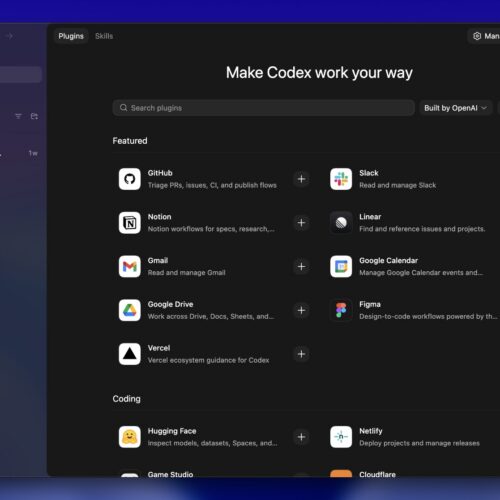
OpenAI has officially expanded its agentic coding app, Codex, by introducing a new plugin feature that bundles skills, app integrations, and MCP servers for easier task configuration. This update aims to align with competitor offerings from Anthropic and Google, allowing users to install external service integrations like GitHub and Gmail with a single click. While power users could previously achieve similar functionality through custom instructions, this feature simplifies the process for broader organizational adoption.
Space Exploration & Policy (2)

NASA's recent Ignition event introduced a controversial plan to replace the aging International Space Station by requiring private companies to build modules that dock with the existing station rather than developing independent free-flying stations. Industry leaders, including the Commercial Spaceflight Federation, have strongly criticized this shift, arguing it undermines commercial innovation and creates confusion regarding the future of low-Earth orbit markets. The controversy highlights a significant tension between NASA's desire for streamlined regulations and the private sector's push for autonomous commercial space stations.

NASA has announced a strategic pivot to repurpose its Gateway lunar outpost hardware for a nuclear-electric propulsion demonstration mission named SR-1 Freedom, targeting a launch before the end of 2028. This initiative aligns with the Trump administration's space policy to focus on building a surface base on the Moon rather than a lunar space station. The mission aims to demonstrate fission power capabilities and efficient mass movement in deep space, utilizing the Power and Propulsion Element currently under construction.